
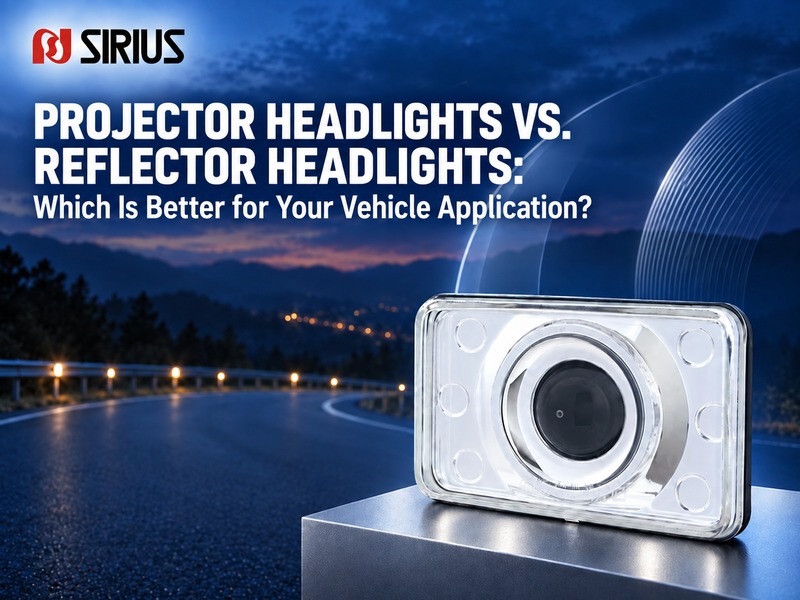
Projector headlights are not automatically better than reflector headlights. Projector systems often provide focused and carefully controlled light distribution, while reflector systems can deliver effective illumination through precisely designed reflective surfaces. The right choice depends on beam requirements, installation space, light source, vehicle application, cost, and target-market requirements.
At SIRIUS LIGHT TECHNOLOGY CO., LTD., we evaluate these factors together when supporting automotive lighting selection and OEM/ODM development. This guide explains how the two optical systems differ and what buyers should confirm before selecting a head lamp for a vehicle project.
1. Quick Answer: Projector vs. Reflector Headlights
Projector headlights use a lens-based optical assembly to form and direct the beam. Reflector headlights rely primarily on shaped reflective surfaces to distribute light onto the road.
A projector headlamp may be considered when a project requires controlled beam distribution, a defined low-beam cut-off, or greater flexibility in front-end styling. A reflector headlight may be preferred when the project requires a more direct structure, flexible housing integration, or tighter cost control.
However, optical architecture alone does not determine headlight quality. Both systems can deliver suitable performance when the light source, optics, housing, electronics, installation, and aiming are properly developed.
Key Takeaways
- Projector and reflector headlights use different methods to shape the beam.
- Either system can provide effective illumination when correctly engineered.
- Projector does not automatically mean brighter or safer.
- Reflector does not automatically mean outdated or less precise.
- The complete headlamp system matters more than the optical structure alone.
2. How Do Projector and Reflector Headlights Work?
Both systems direct light ahead of a vehicle, but their internal optical structures form the beam differently.
How Projector Headlights Work
A projector headlight typically collects light through a reflector or optical bowl and directs it through a lens. Many low-beam projector designs also use a shield to help create the cut-off line and control light above the intended illumination area.
The lens does not simply increase brightness. It works with the light source, reflector, shield, and other optical components to form the required beam pattern. Depending on the design, a projector system may provide:
- Focused light distribution
- A clearly defined low-beam cut-off
- Controlled placement of light on the road
- Flexibility for distinctive vehicle styling
- A relatively small visible aperture
A small visible opening does not necessarily mean the complete lamp requires less installation space. Some projector modules need sufficient depth behind the lens to accommodate their optical components.
Not all projector lamps have the same internal configuration. A low-beam projector headlight, a high-beam module, and a projector-type auxiliary lamp perform different functions and may use different optical arrangements.
For example, our NS-2228L 165mm Low Beam Headlamp features a built-in projector low beam and uses a halogen light source. This demonstrates that “projector” describes the optical design rather than the light-source technology.
How Reflector Headlights Work
A reflector headlight positions the light source in relation to a shaped reflective surface. The reflector collects the emitted light and redirects it into the required road-lighting pattern.
Traditional systems commonly used relatively simple parabolic reflectors. Modern automotive lighting can use multi-surface or free-form reflector designs in which different reflector sections direct light toward specific areas.
The performance of a reflector headlight depends on:
- Reflector geometry
- Light-source position
- Reflective surface quality
- Lens design
- Housing alignment
- Assembly tolerances
- Photometric validation
Modern reflector headlights should therefore not be treated as inherently less accurate. Their performance depends on how well the complete optical system is designed and manufactured.
Key Takeaways
- “Projector” and “reflector” describe optical structures, not light-source types.
- Many low-beam projectors use a shield, but configurations vary by lighting function.
- Modern multi-surface reflectors can produce precisely controlled light distribution.
- Optical performance depends on design accuracy and manufacturing consistency.
3. Projector Headlights vs. Reflector Headlights: Key Differences
The following table presents general design tendencies. Actual results depend on the individual product, light source, vehicle installation, and performance requirements.
| Comparison Factor | Projector Headlights | Reflector Headlights |
|---|---|---|
| Optical principle | Direct light through a lens-based optical assembly | Direct light primarily through shaped reflective surfaces |
| Beam control | Can support focused and carefully defined light distribution | Can provide controlled distribution through multi-surface or free-form reflectors |
| Low-beam cut-off | Many designs use a shield to help create a defined cut-off | Usually formed through reflector geometry and lens design |
| Glare management | Can provide effective control when correctly designed and aimed | Can also control glare through accurate optics, source positioning, and aiming |
| Visible opening | Often uses a relatively small visible aperture | Often requires a larger reflective area |
| Installation space | May require additional depth for the optical module | Depends on reflector size and housing geometry |
| Styling flexibility | Supports distinctive and modular front-end designs | Offers flexibility through different reflector and housing shapes |
| Manufacturing complexity | Often involves additional components and precise assembly | May use fewer components, although advanced reflector tooling remains demanding |
| Cost considerations | Optical and assembly complexity may increase cost | Can be more cost-effective depending on specifications and tooling |
| Light-source compatibility | Can be engineered for LED, halogen, or other sources | Can also be engineered for LED, halogen, or other sources |
These differences should be treated as selection considerations rather than fixed advantages. A projector may provide a compact visible appearance but require more depth, while a reflector may occupy more frontal area but fit better within a particular vehicle structure.
Key Takeaways
- Compare usable beam performance rather than appearance alone.
- Consider both the visible opening and the space behind the lamp.
- Glare control depends on optical design, installation, and aiming.
- Cost varies according to materials, tooling, electronics, and performance targets.
4. LED vs. Halogen: How Does the Light Source Affect Each System?
The comparison between LED and halogen headlights is often reduced to brightness, wattage, or color. For OEM headlights, the more important question is whether the complete optical system was designed around the selected light source.
Halogen in Projector and Reflector Systems
A halogen bulb produces light from a filament at a defined position. The reflector and lens are designed around that position to form the intended beam.
Halogen light sources can be used in both projector and reflector headlights. Their electrical configuration is relatively familiar, and the bulb can usually be replaced separately. However, power consumption, generated heat, packaging, and maintenance requirements still need to be evaluated.
LED in Projector and Reflector Systems
LEDs can also be integrated into either optical structure. However, an LED emitter differs from a halogen filament in size, light-emitting surface, heat path, and electrical requirements.
An integrated LED headlamp may require:
- Dedicated reflector or lens geometry
- LED driver design
- Thermal protection
- Surge protection
- Heat dissipation
- Electromagnetic compatibility
- Controlled assembly tolerances
We support electronic development for applications such as LED drivers, thermal protection, surge protection, and failure-detection modes according to customer testing and EMC requirements. These electronic elements must be coordinated with the optical and mechanical design.
5. Which Headlight Design Fits Different Vehicle Applications?
Vehicle type alone does not determine whether projector or reflector headlights should be used. The decision should reflect the lamp’s function, installation conditions, target market, and actual operating environment.
Passenger Cars
Passenger-car headlights often need to balance road illumination, front-end styling, packaging, energy use, and cost. Either optical system may be suitable when designed for the required vehicle platform.
Trucks and Buses
Commercial vehicles may require long operating hours, 12V or 24V compatibility, stable mounting, maintenance access, and reliable high- and low-beam performance.
Agricultural Vehicles
Agricultural machinery often operates in dust, mud, moisture, and vibration. Road-going headlamps should be distinguished from work lamps used to illuminate fields, implements, and nearby work areas.
Construction Vehicles
Construction equipment may operate on public roads, private worksites, or both. Buyers must identify whether the lamp functions as a regulated headlamp, auxiliary lamp, or work lamp.
Specialty and Off-Road Vehicles
These projects may involve restricted installation space or unusual lighting requirements. Off-road lamps and road-use headlights are not automatically interchangeable.
Key Takeaways
- Start with the lamp’s intended function rather than vehicle category alone.
- Separate primary road lighting from auxiliary and work-area illumination.
- Evaluate installation, voltage, durability, maintenance, and market requirements together.
6. What Should OEM Buyers Confirm Before Selecting a Headlamp?
For an OEM/ODM automotive lighting project, choosing between projector and reflector optics is only one part of the development process. Buyers should provide clear requirements so the manufacturer can determine whether an existing product or a customized design is more appropriate.
Intended Lighting Function
Confirm whether the lamp will provide low beam, high beam, combined high/low beam, position lighting, daytime running lighting, indicator lighting, fog lighting, or auxiliary driving illumination.
Target Market and Regulatory Requirements
The destination market should be defined at the beginning. Depending on the application, development may need to address UNECE type-approval requirements, applicable U.S. requirements including FMVSS No. 108, relevant SAE standards, other destination-market regulations, and customer-specific specifications.
UNECE type approval, U.S. manufacturer self-certification, and SAE standards are not identical systems. Their terminology and procedures should not be used interchangeably.
Official references: UNECE UN Regulation No. 149 and U.S. FMVSS No. 108 .
Photometric Performance
Define the required beam function, photometric targets, light distribution, low-beam cut-off, high-beam illumination, and traffic direction where applicable.
Our photometric laboratory uses a computer-controlled LMT goniometer linked to photocells at 5- and 25-meter positions. We combine optical simulation, rapid prototyping, and photometric measurement to evaluate lighting performance according to project requirements.
Mechanical Integration
Provide the available installation envelope, mounting points, lamp orientation, adjustment method, connector position, surrounding components, and styling requirements. The complete installation space matters more than the visible lens or reflector size alone.
Electrical and Electronic Requirements
Confirm nominal voltage, operating range, possible voltage fluctuations, connector and wiring requirements, LED driver requirements, surge and thermal protection, failure-detection requirements, and EMC targets.
Operating Environment
The validation plan should reflect temperature, humidity, rain, dust, shock, vibration, corrosive exposure, operating duration, and cleaning conditions.
We maintain equipment for temperature and humidity, rain, dust, shock, vibration, salt spray, and other customer-specific evaluations. Test conditions and acceptance criteria should still be defined for each individual project.
Production and Customization
For a customized project, establish forecast production volume, tooling responsibility, design ownership, sample and validation schedules, certification responsibility, quality documentation, and mass-production inspection requirements.
Information to Include in an OEM Headlight Inquiry
- Vehicle type and application
- Required lighting functions
- Target market
- Preferred light source
- Mounting dimensions
- Electrical specifications
- Operating environment
- Applicable requirements
- Estimated production volume
- Required customization
7. Frequently Asked Questions
Are projector headlights always brighter than reflector headlights?
No. Usable illumination depends on the complete optical design, light source, thermal conditions, assembly accuracy, and headlamp aiming—not the optical architecture alone.
Do projector headlights provide better glare control?
Projector headlights can provide precise beam control, particularly when a low-beam design uses a properly engineered shield and lens. However, modern reflector headlights can also achieve controlled light distribution through suitable reflector geometry and accurate light-source positioning. Both systems must be correctly installed and aimed.
Can LED bulbs be installed in reflector headlights designed for halogen bulbs?
Physical installation does not guarantee optical, electrical, thermal, or regulatory compatibility. If the LED does not reproduce the light-emitting position expected by the halogen optics, the beam pattern may change and glare may increase. Confirm the lamp’s approved configuration and applicable local requirements before replacing the original light source.
Do projector and reflector headlights follow different ECE or SAE requirements?
Applicable requirements are generally determined by the lamp’s function, measured performance, configuration, installation, and target market—not simply by whether the lamp uses projector or reflector optics. Both systems must meet the requirements applicable to their intended use.
Choose the Complete Headlamp System, Not Just the Optical Structure
The choice between projector and reflector headlights should begin with the required vehicle function—not with appearance or assumed brightness. The final decision should balance optical performance, vehicle integration, electrical and thermal requirements, operating conditions, production needs, and target-market compliance.
We support automotive lighting projects with mechanical, electronic, and optical design, rapid prototyping, photometric measurement, environmental testing, manufacturing, and production quality control. This allows us to evaluate existing products and OEM/ODM development requirements according to the actual application.
If you are planning a headlamp project, provide the vehicle type, target market, required lighting functions, installation dimensions, electrical specifications, operating environment, and compliance requirements. Our team can help identify an appropriate product or development direction.