
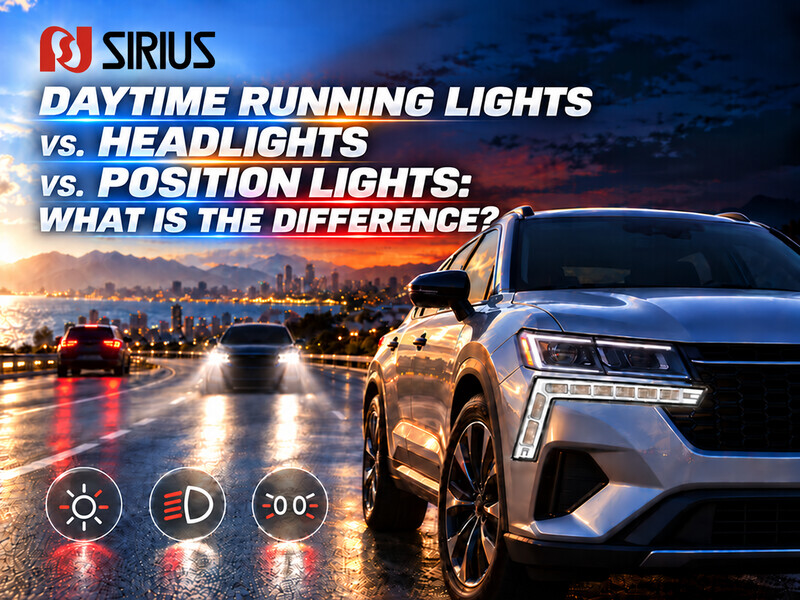
Daytime running lights, headlights, and position lights may look similar, but they serve different purposes. Daytime running lights help other road users notice a vehicle during the day, headlights illuminate the road ahead, and position lights indicate the vehicle's presence and position.
At SIRIUS LIGHT TECHNOLOGY CO., LTD., we provide automotive lighting products for passenger vehicles, trucks, buses, commercial vehicles, and heavy-duty equipment. When helping customers select or develop vehicle lighting, we begin with the required lighting function—not simply the lamp's appearance, wattage, or number of LEDs.
This guide explains how these automotive lighting functions differ, how they serve different driving conditions, how multiple functions may be combined, and what OEM buyers should define before selecting a daytime running lamp or developing a multi-function front lamp.
1. Quick Answer: DRL vs. Headlights vs. Position Lights
The simplest way to understand the difference is to ask whether the lamp helps other road users see the vehicle or helps the driver see the road.
Daytime running lights (DRLs) are primarily intended to improve daytime vehicle conspicuity. Headlights provide controlled forward road illumination. Position lights indicate the vehicle's presence and position under the operating conditions defined for the vehicle and target market.
| Comparison | Daytime Running Lights | Headlights | Position Lights |
|---|---|---|---|
| Primary purpose | Improve daytime vehicle visibility | Illuminate the road ahead | Indicate vehicle presence and position |
| Typical use | Daytime vehicle operation | Nighttime and reduced-visibility driving | Low-light conditions or a defined vehicle-lighting sequence |
| Road illumination | Not the primary function | Yes | Not the primary function |
| Common configuration | Dedicated DRL or integrated function | Low beam, high beam, or combined high/low beam | Dedicated or integrated position function |
| Possible integration | Position lamp, indicator, fog lamp, or headlamp | DRL or position light | DRL, indicator, headlamp, or fog lamp |
| Main selection factors | Visibility, installation, voltage, and control | Beam pattern, photometric performance, and application | Visibility, identification, and system integration |
A lamp's appearance does not establish its function. Two products may use similar LEDs or housings while producing different light distributions. A bright daytime running lamp is not automatically suitable for nighttime road illumination; a head lamp must distribute light into the required road areas while controlling unwanted light and glare.
Key Takeaways
- DRLs help other road users notice the vehicle during the day.
- Headlights help the driver see the road ahead.
- Position lights indicate the vehicle's presence and position.
- Similar appearance does not mean the lamps perform the same function.
- Confirm the intended lighting function before selecting a product.
2. What Are Daytime Running Lights and What Do They Do?
Daytime running lights are forward-facing vehicle lights designed primarily to make a moving vehicle easier to detect during daylight. Unlike low-beam headlights, a daytime running lamp is not principally designed to provide nighttime road illumination.
How DRLs operate depends on the vehicle's electrical architecture, control logic, selected lamp, and applicable market requirements. Depending on the vehicle design, DRLs may operate when the vehicle is switched on or placed in a defined operating condition. Their output may dim, switch off, or change when another lighting function is activated.
DRL Operating Logic to Define
- When the DRL activates
- When it dims or switches off
- How it interacts with position lights
- How it responds when an indicator is activated
- Whether the vehicle uses separate or integrated lamp modules
- Whether the configuration is suitable for the destination market
Front DRL operation does not necessarily mean every other exterior lamp is active. Drivers should follow the vehicle manufacturer's instructions rather than assume that illuminated front DRLs provide all the lighting required for darkness or reduced visibility.
SIRIUS offers dedicated LED daytime running lights in round, flexible, and multi-function configurations. Voltage, lighting functions, ingress-protection ratings, and certification information vary by model, so buyers should evaluate the specifications of the individual product.
Key Takeaways
- DRLs are intended primarily for daytime vehicle conspicuity.
- They are not substitutes for low-beam headlights at night.
- Activation and dimming logic depend on the vehicle and lamp design.
- Front DRL operation does not necessarily activate every exterior lamp.
3. How Do DRL, Headlights, and Position Lights Serve Different Driving Conditions?
Different driving conditions require different lighting functions. DRLs, headlights, and position lights should not be treated as progressively brighter versions of the same lamp.
Daytime Driving
DRLs improve vehicle recognition during normal daylight operation. They may be designed as dedicated lamps or integrated into another front-lighting assembly.
Nighttime Driving
Headlights provide controlled forward illumination. Low beams support road visibility while controlling glare; high beams provide a different distribution for appropriate conditions.
Tunnels and Low-Light Conditions
The regular road-lighting system may be needed when a vehicle enters a tunnel or low-light environment. Automatic activation logic varies by vehicle.
Rain, Fog, and Reduced Visibility
The appropriate function depends on the vehicle, operating condition, manufacturer instructions, and applicable market requirements.
Vehicle Position Identification
Position lights indicate the vehicle's presence and position rather than illuminate the road. Terminology can differ across regulatory systems.
Because terminology and required operation vary by market, terms such as position lamp and parking lamp should not automatically be treated as technically or legally identical. For regulatory evaluation, buyers may consult the applicable UNECE vehicle regulations or relevant national requirements.
Key Takeaways
- Driving conditions determine which lighting function is needed.
- DRLs support daytime vehicle recognition.
- Headlights provide controlled forward road illumination.
- Position lights identify the vehicle's presence and position.
4. Can DRL, Position, and LED Turn Signal Functions Be Combined?
Yes. A single lamp assembly can incorporate daytime running, position, and LED turn signal functions when the optical, electronic, and mechanical systems are developed together.
Combining functions involves more than placing LEDs of different colors in one housing. Each function may require its own light distribution, intensity, color, illuminated area, and operating sequence. Development may therefore include:
- Optical distribution and illuminated surface for each function
- Intensity, color, and functional priority
- Dimming, switching, and indicator-recognition behavior
- LED driver, electrical inputs, and control design
- Thermal management and electromagnetic compatibility
- Housing, lens, sealing, mounting position, and available space
For example, when an indicator operates near or within a DRL, the control sequence may need to change so that the turn signal remains clearly recognizable. The exact strategy depends on the lamp configuration, vehicle control system, and applicable requirements.
SIRIUS Multi-Function Product Examples
NS-4215 LED Daytime Running/Position/Indicator Light
- 24V configuration; 12V option available upon request
- IP66 ingress protection
- EMI Class 3 according to CISPR 25
- Right-hand and left-hand configurations
NS-4210 LED Daytime Running Light & Position Light
- DRL and position-light functions
- Multivolt 9–33V DC operation
- IP68 ingress protection
- External driver
NS-2875 LED Front Indicator/Position/Daytime Running Lamp
- 12V configuration
- LED light source
- EMI Class 3 according to CISPR 25
- Right-hand and left-hand configurations
These examples use different voltage, sealing, control, and certification configurations. The certification wording above follows the information displayed on the respective SIRIUS product pages and should not be interpreted as a universal approval claim. Suitability must be confirmed for the intended vehicle and market.
Key Takeaways
- Multiple lighting functions can be integrated into one lamp assembly.
- Each function requires appropriate optical and electronic control.
- Integrated styling does not eliminate engineering and validation requirements.
- Voltage, protection, and certification information vary by model.
5. How Should OEM Buyers Specify DRL and Front Lighting Functions?
For an OEM or ODM automotive lighting project, buyers should begin with a clear function matrix and control sequence. A request such as “We need an LED front lamp” does not provide enough information to select a product or evaluate a customized design.
At SIRIUS LIGHT TECHNOLOGY CO., LTD., we review the application information to determine whether an existing product or a customized development direction may be more suitable.
Required Function Matrix
| Function | Required | Operating Condition | Interaction With Other Functions |
|---|---|---|---|
| DRL | Yes / No | Define activation condition | Dim, switch off, or remain active |
| Position light | Yes / No | Define activation condition | Define interaction with DRL |
| Front indicator | Yes / No | Turn signal or hazard operation | Define priority over DRL |
| Low beam | Yes / No | Headlamp operation | Define interaction with DRL |
| High beam | Yes / No | High-beam operation | Define interaction with other functions |
| Fog lamp | Yes / No | Define operating condition | Define interaction with DRL or position light |
The matrix should reflect the actual vehicle architecture and destination-market requirements rather than being treated as a universal operating sequence.
Control Sequence
- DRL activation, dimming, and switch-off conditions
- Position-light activation
- Indicator priority and hazard-warning operation
- Headlamp and fog-lamp interaction, if applicable
- Failure-detection behavior and vehicle control-module signals
Vehicle and Market Information
- Vehicle type and application
- Destination market and traffic direction
- Left-hand or right-hand installation requirements
- Required markings, certification information, and customer validation
Electrical and Mechanical Information
- Nominal and operating voltage
- Connector, pin assignment, input signals, and wiring
- EMC, surge protection, and failure-detection requirements
- Installation envelope, depth, mounting points, and lamp orientation
- Connector location, surrounding components, and illuminated-surface requirements
Environmental and Project Requirements
- Water, dust, temperature, humidity, vibration, shock, and corrosive exposure
- Photometric and environmental validation requirements
- Sample and approval schedule
- Estimated production volume, customization, and tooling expectations
SIRIUS has published capabilities in mechanical design, electronics design, optical design and simulation, rapid prototyping, photometric measurement, environmental testing, manufacturing, and quality control. The required tests and acceptance criteria should still be agreed upon for each project. For U.S.-market programs, buyers can also consult NHTSA's Federal Motor Vehicle Safety Standards information.
Key Takeaways
- Begin with a function matrix and control sequence.
- Define how DRL interacts with position, indicator, and headlamp functions.
- Provide electrical, mechanical, environmental, and project information.
- Confirm the destination market before finalizing the specification.
- Evaluate certification information at the individual product level.
6. Frequently Asked Questions
Can daytime running lights replace headlights at night?
No. DRLs are primarily intended to improve vehicle visibility during daylight. They do not provide the same controlled forward road illumination as low-beam headlights.
Are daytime running lights and position lights the same?
No. DRLs support daytime vehicle conspicuity, while position lights indicate the vehicle's presence and position. Both functions may be integrated into one lamp, but they remain distinct functions.
Do daytime running lights turn on automatically?
Many vehicle systems activate DRLs automatically under defined conditions, but the exact logic varies by vehicle, lamp, and market. Interaction with headlights, position lights, and indicators should be confirmed for the specific application.
Can DRL and LED turn signal lights be integrated into the same lamp?
Yes. DRL, position, and indicator functions can be combined when the optics, electronics, and control sequence are engineered together. Each function must remain recognizable and satisfy the applicable product and market requirements.
What information should OEM buyers provide when requesting a DRL or headlamp?
Provide the vehicle type, required functions, function matrix, control sequence, destination market, voltage, mounting dimensions, connector information, operating environment, validation requirements, estimated quantity, and customization needs.
Define the Lighting Function Before Selecting the Product
SIRIUS provides dedicated daytime running lamps and multi-function products combining DRL with position, indicator, fog-lamp, or headlamp functions. Send us your function matrix, control sequence, electrical specifications, mounting information, operating environment, and destination-market requirements. We can review whether an existing SIRIUS product or a customized development direction is appropriate.
Explore Daytime Running Lights Contact SIRIUS