
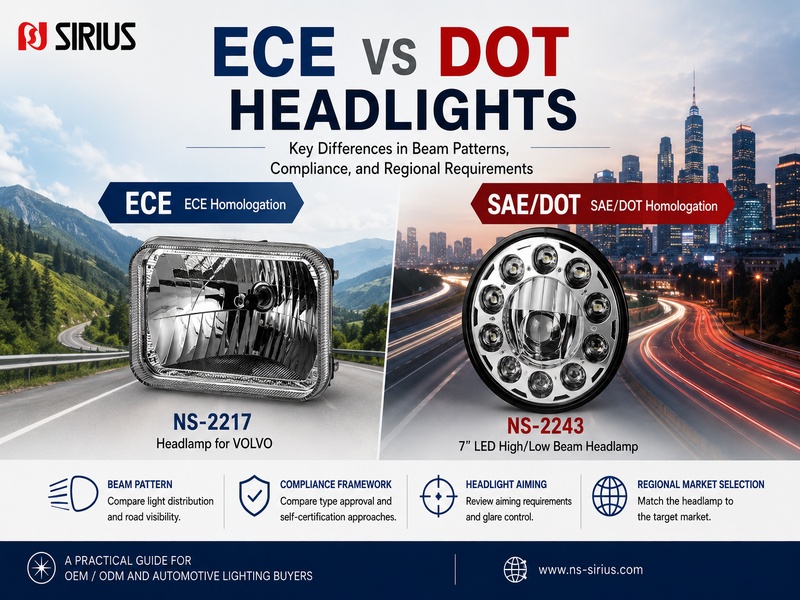
ECE vs DOT Headlights: Key Differences in Beam Patterns, Compliance, and Regional Requirements
When sourcing headlights for different vehicle markets, choosing the right lamp involves more than comparing size, wattage, or light output. Regional automotive lighting regulations can affect beam distribution, product markings, compliance procedures, and whether a headlamp is suitable for its intended market.
This makes ECE vs DOT headlights an important topic for vehicle manufacturers, automotive lighting buyers, distributors, and aftermarket brands supplying products across multiple regions.
In common industry language, “ECE headlights” generally refers to headlamps approved under applicable UNECE regulations, while “DOT headlights” is often used as shorthand for headlamps intended for the U.S. market. Technically, U.S. headlighting equipment must comply with applicable Federal Motor Vehicle Safety Standards, particularly FMVSS No. 108, under a manufacturer self-certification system.
ECE and U.S.-market headlights follow different regulatory frameworks. UNECE-regulated headlamps generally use a type-approval system and applicable E-marking, while U.S. headlamps must meet applicable FMVSS No. 108 requirements through manufacturer self-certification. Differences may also affect photometric requirements, beam distribution, product markings, traffic-direction considerations, and regional application.
For automotive lighting buyers, the important question is therefore not “Which system is better?” but: Which headlight configuration, compliance framework, and beam performance are appropriate for the target vehicle and destination market?
1. What Are ECE and DOT Headlights?
The terms ECE headlights and DOT headlights are widely used in automotive lighting discussions, but the underlying regulatory systems are different.
An ECE headlight generally refers to a headlamp approved according to an applicable UN Regulation within the UNECE vehicle regulatory framework. For road illumination devices, UN Regulation No. 149 covers functions including passing beams and driving beams and establishes requirements related to photometric performance, approval, and marking.
“DOT headlight,” on the other hand, is common industry shorthand for a headlamp intended for the U.S. market. In the United States, automotive lighting is governed by FMVSS No. 108 – Lamps, Reflective Devices, and Associated Equipment , administered by the National Highway Traffic Safety Administration.
One important distinction is that NHTSA does not individually pre-approve every headlamp before it enters the market. Manufacturers are responsible for certifying that regulated products comply with all applicable Federal Motor Vehicle Safety Standards.
- ECE commonly refers to the UNECE type-approval framework.
- Headlights intended for the U.S. market must meet applicable FMVSS No. 108 requirements.
- DOT marking should not be interpreted as individual product approval by NHTSA.
- Applicable regulations should be confirmed according to the target market and vehicle application.
2. ECE vs DOT Headlights at a Glance
Both regulatory frameworks are intended to support safe vehicle lighting, but their compliance structures and technical requirements are not identical.
| Comparison | ECE / UNECE Framework | U.S. FMVSS Framework |
|---|---|---|
| Regulatory framework | Applicable UN Regulations | FMVSS No. 108 |
| Compliance approach | Type approval | Manufacturer self-certification |
| Typical regulatory marking | E-mark / approval marking | Applicable U.S. certification markings, including DOT where required |
| Photometric requirements | Defined by applicable UNECE regulations | Defined by FMVSS No. 108 |
| Traffic-direction considerations | May distinguish right-hand and left-hand traffic applications | Based on applicable U.S. requirements |
| Buyer focus | Verify applicable regulation and type approval | Verify applicable FMVSS compliance |
This comparison provides a useful overview, but buyers should not assume that every ECE headlamp has one universal beam pattern or that every U.S.-market headlamp has another.
The exact requirements depend on factors such as headlamp function, optical design, vehicle application, traffic direction, and the regulation applicable to the specific product.
SIRIUS' product portfolio illustrates why product-level verification matters. The company offers multiple automotive headlamps with different functions, dimensions, homologation information, and light-distribution data for application evaluation.
3. How Headlight Compliance Differs Between UNECE and U.S. FMVSS 108
In everyday industry discussions, “ECE vs DOT” is convenient shorthand. More precisely, the comparison involves the UNECE type-approval framework and U.S. compliance with FMVSS No. 108 .
Under the UNECE framework, lighting devices covered by applicable UN Regulations generally follow a type-approval system. Approved products carry the relevant approval markings according to the regulation and lighting function.
The United States follows a different compliance model. NHTSA establishes Federal Motor Vehicle Safety Standards but does not normally approve individual lighting products before sale. Manufacturers must instead self-certify that regulated equipment meets all applicable requirements.
This distinction matters to B2B buyers because several commonly used terms refer to different concepts:
- ECE type approval
- E-mark
- SAE requirements or standards
- DOT marking
- FMVSS No. 108 compliance
An SAE designation should not automatically be treated as identical to complete FMVSS No. 108 compliance. Buyers should confirm the actual documentation and regulatory status of the specific model being sourced for the intended market.
- UNECE generally uses type approval.
- The U.S. uses manufacturer self-certification to applicable FMVSS requirements.
- ECE, SAE, DOT, and FMVSS terminology should not be used interchangeably.
- Compliance should be verified for the specific product, vehicle application, and destination market.
4. How Do ECE and DOT Headlight Beam Patterns Differ?
Beam pattern is one of the most important technical factors when comparing headlights intended for different regional applications.
A headlamp is not designed simply to produce the highest possible lumen output. The optical system must distribute light to useful areas of the road while controlling light in areas where it could cause glare or reduce visual comfort.
Depending on the lighting function and applicable regulation, engineers may need to consider:
- Passing beam / low beam distribution
- Driving beam / high beam distribution
- Cutoff characteristics
- Photometric test points and zones
- Forward visibility
- Glare control
- Right-hand or left-hand traffic
- Headlamp mounting and aiming
UNECE and U.S. regulations use their own photometric criteria and test requirements. For that reason, comparisons should not be reduced to statements such as “ECE has a cutoff while DOT does not” or “one type is always brighter.”
The actual light distribution depends on the specific headlamp design and regulatory configuration.
For an automotive lighting buyer, light distribution is often more meaningful than lumen output alone. Two headlights with similar wattage or apparent brightness can perform differently if their optics distribute light into different road zones.
SIRIUS' Head Lights portfolio includes dedicated low-beam, high-beam, and combined high/low-beam products in several configurations, with individual product pages providing Light Distribution information for application evaluation.
- Beam pattern describes controlled light distribution, not brightness alone.
- Low beam and high beam serve different optical functions.
- Photometric requirements vary by regulatory framework and product function.
- Traffic direction may affect the appropriate passing-beam configuration.
- Similar dimensions do not guarantee identical regulatory or optical performance.
5. Why Correct Headlight Aiming Matters for Beam Performance and Glare Control
Correct headlight aiming is closely related to beam performance because even a properly designed optical system may not provide its intended road illumination if the headlamp is installed or aimed incorrectly.
A headlamp aimed too high may increase glare toward other road users. One aimed too low may reduce useful forward visibility.
This is also why a search for how to aim headlights should not be answered with one universal adjustment angle.
The correct procedure depends on:
- Headlamp design
- Mounting height
- Vehicle geometry
- Applicable requirements
- Vehicle or lamp manufacturer instructions
From a technical perspective, the most important checks include:
- Correct and secure headlamp installation
- Vehicle condition and loading appropriate for adjustment
- Identification of the relevant optical or reference axis
- Alignment according to the applicable vehicle or headlamp procedure
The goal of aiming is not to redesign the beam pattern. It is to position the designed beam correctly on the road.
- Correct aiming helps preserve intended optical performance.
- Excessively high aim can increase glare.
- Excessively low aim can reduce useful visibility.
- There is no single aiming setting for every ECE or U.S.-market headlamp.
- Vehicle and headlamp manufacturer procedures should take priority over generic online measurements.
6. How Regional Regulations Affect Headlight Selection
For an international automotive project, the destination market should be defined before the headlamp specification is finalized.
A headlamp selected for a U.S. vehicle program may need to satisfy different regulatory and photometric requirements from one intended for a market applying UNECE regulations.
This remains true even when two lamps:
- Fit the same opening
- Use similar connectors
- Have similar dimensions
- Provide comparable high- and low-beam functions
Physical compatibility does not automatically establish regulatory compatibility.
Traffic direction may also affect headlamp selection. This is why the intended application should be checked at the individual product level rather than relying only on dimensions, connectors, or appearance.
- Begin selection with the destination market.
- Similar physical specifications do not guarantee cross-market compliance.
- Confirm traffic direction where it affects passing-beam configuration.
- Regulatory requirements should be considered before tooling or vehicle integration is finalized.
- A global vehicle platform may require different regional lighting variants.
7. What Specifications Should Automotive Lighting Buyers Confirm Before Sourcing Headlights?
Once the target regulatory framework has been identified, buyers can focus on the actual headlight specification.
This is intentionally different from choosing an automotive lighting supplier. The question here is not “Which supplier is best?” but:
What information should be confirmed before a headlamp is selected, quoted, or developed?
Target Market and Regulatory Framework
Confirm the country or region where the vehicle or replacement product will be sold and identify the applicable lighting requirements.
Required Lighting Functions
- Low beam
- High beam
- Combined high / low beam
- Position lamp
- Daytime running lamp
- Indicator integration
Beam Pattern and Light Distribution
Review optical performance according to the required lighting function rather than selecting a lamp solely by wattage or lumen output.
Vehicle Electrical Requirements
Confirm the relevant system voltage and electrical integration requirements.
Mounting and Packaging
- Mounting dimensions
- Installation depth
- Mounting points
- Connector location
- Housing clearance
- Surrounding vehicle structure
Environmental and Electrical Performance
- Sealing
- Vibration resistance
- Thermal management
- Temperature exposure
- EMC requirements
OEM / ODM Development Requirements
For a new vehicle platform or a market-specific program, an existing catalog product may not meet every requirement.
Optical design, electronics, mechanical integration, appearance, validation, and regulatory considerations may need to be developed together.
SIRIUS' in-house capabilities include mechanical, electronics, and optical design and photometric testing . These capabilities are relevant to buyers evaluating a headlamp not only by catalog specifications, but also by beam performance, vehicle integration, target-market requirements, and product development needs.
Before contacting an automotive lighting manufacturer, prepare:
- Vehicle type and application
- Destination market
- Required lighting functions
- Mounting dimensions
- Electrical requirements
- Operating environment
- Applicable compliance or approval requirements
- OEM / ODM customization needs, if any
8. Frequently Asked Questions About ECE vs DOT Headlights
1. What is the main difference between ECE and DOT headlights?
2. Can an ECE-approved headlight be used in the United States?
3. Can a U.S.-market headlight be used in Europe?
4. Do ECE and DOT headlights have different beam patterns?
5. What does DOT marking on a headlight mean?
6. What does an E-mark on a headlight mean?
7. Does headlight aiming differ between ECE and U.S.-market headlights?
8. What should automotive lighting buyers provide when requesting a headlight quotation?
- Vehicle type
- Target market
- Required beam functions
- Mounting dimensions
- Electrical requirements
- Traffic direction where relevant
- Operating environment
- Required compliance or homologation
Choosing the Right Headlight Starts With the Target Market
The difference between ECE vs DOT headlights goes beyond product markings. It involves different regulatory frameworks, compliance procedures, photometric requirements, beam considerations, and regional applications.
For automotive lighting buyers, the most reliable selection process is to define the destination market first, then evaluate:
SIRIUS LIGHT TECHNOLOGY CO., LTD. offers a broad Head Lights portfolio that includes low-beam, high-beam, and combined high/low-beam configurations.
The company also supports mechanical, electronic, and optical design together with photometric testing for automotive lighting development.
Looking for a Headlight Solution for Your Target Market?
For an OEM / ODM project or market-specific headlamp requirement, provide your vehicle application, destination market, required beam functions, mounting dimensions, electrical requirements, and compliance needs.
Defining these requirements early helps establish the right direction for product selection, optical development, vehicle integration, and validation.
More Automotive Lighting Insights
Continue exploring vehicle lighting selection, beam performance, supplier evaluation, and application considerations.
Official References
- National Highway Traffic Safety Administration (NHTSA) – FMVSS No. 108 and manufacturer self-certification: NHTSA Official Reference
- United Nations Economic Commission for Europe (UNECE) – UN Regulation No. 149: UN Regulation No. 149
- SIRIUS LIGHT TECHNOLOGY CO., LTD. – testing, homologation, optical design, and product development capabilities: SIRIUS Quality, Testing and Design