
2026.07.20
What to Check Before Choosing an Automotive Lighting Supplier?
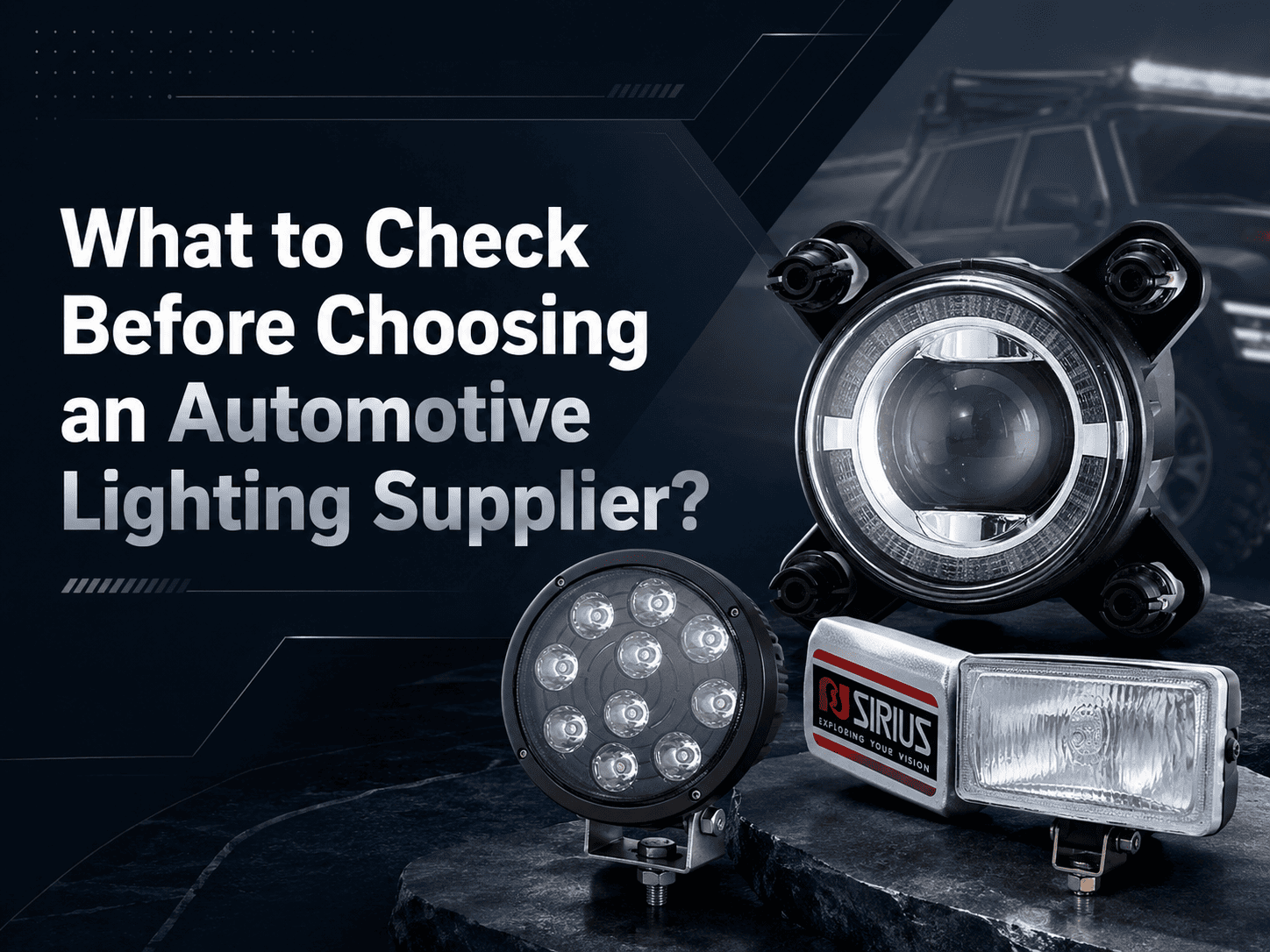
Choosing the right automotive lighting supplier is not only about price. Buyers should also consider product quality, development capability, and whether the supplier can support different vehicle and equipment applications.
Automotive lighting is closely related to driving safety, nighttime visibility, working efficiency, and long-term product reliability. From passenger cars, motorcycles, trucks, and buses to agricultural machinery, construction vehicles, marine equipment, and special-purpose vehicles, each application has different lighting requirements. Therefore, when selecting an automotive lighting supplier, buyers should evaluate the supplier’s product range, development capability, regulatory knowledge, optical design, durability, production stability, and application experience.
For customers looking for an automotive lighting supplier, automotive lighting manufacturer, or automotive LED lighting solution, the right partner should do more than provide products. A reliable supplier should help solve real lighting challenges in different vehicle and equipment applications.
SIRIUS Light Technology Co., Ltd. provides vehicle and industrial lighting products, including essential lighting, auxiliary lighting, work lamps, and related accessories to support different market and application needs.
Table of Contents
Is Price the Only Factor When Choosing an Automotive Lighting Supplier?
Price is often one of the first factors buyers consider, but it should not be the only standard when selecting automotive lighting products. Vehicle lighting is different from general lighting because it affects driving safety, working visibility, regulatory compliance, and future maintenance costs.
A lower-priced lamp may seem attractive at the beginning. However, if it later develops problems such as water leakage, fogging, reduced brightness, unstable beam patterns, housing deterioration, or electronic failure, the cost of repair, replacement, and customer complaints may be much higher than the initial savings.
This is especially important for commercial vehicles, construction machinery, agricultural equipment, and outdoor applications. Lighting products in these environments often need to operate for long hours while facing vibration, rain, dust, mud, and temperature changes. If the supplier only provides basic products without design, testing, and application knowledge, the product may not perform well in real operating conditions.
When choosing an automotive lighting supplier, buyers should look at the overall cooperation value. In addition to price, it is important to evaluate whether the supplier can provide stable quality, product development support, regulatory understanding, testing capability, and long-term supply reliability.
Does the Supplier Offer a Complete Automotive Lighting Product Line?
Automotive lighting covers a wide range of products. Different vehicles, installation positions, and applications require different types of lamps. Basic vehicle lighting may include headlamps, tail and rear lamps, daytime running lights, indicator lamps, marker lamps, license lamps, and center high-mounted stop lamps.
Special-purpose vehicles, trucks, buses, construction vehicles, and agricultural machinery may also require auxiliary lamps, fog lamps, driving lights and spot lamps, warning lamps, off-road lights, or work lamps. Before choosing a supplier, customers should confirm whether the supplier offers a complete automotive lighting product line.
A broader product range means the supplier can support more vehicle platforms and application needs. It also makes it easier for customers to integrate different lighting products under one cooperation framework.
For vehicle manufacturers, equipment manufacturers, and overseas distribution customers, working with one supplier for multiple lighting products can reduce communication costs and help maintain consistent product appearance, quality standards, and supply stability. On the other hand, if a supplier only provides one limited product category, customers may need to search for another partner when expanding to new vehicle models or applications.
SIRIUS provides vehicle and industrial lighting products covering essential lighting, auxiliary lighting, work lamps, and accessories. For customers who need long-term cooperation or multi-product purchasing, a complete product line is an important factor when evaluating a supplier.
Does the Automotive Lighting Manufacturer Have Development Capability?
In the automotive lighting industry, a supplier is not only a product provider. In many cases, the supplier also needs to support product development. Different vehicle models and equipment types may have different installation spaces, voltage requirements, appearance designs, beam angle needs, thermal conditions, and market regulations.
When choosing an automotive lighting manufacturer, customers should confirm whether the supplier has mechanical design, electronic design, optical design, rapid prototyping, and sample validation capabilities. These abilities affect whether a product can move smoothly from concept to mass production. They also influence product stability and market suitability.
For example, the lamp housing needs to consider mounting method, structural strength, and sealing performance. Electronic design needs to consider voltage stability, heat dissipation, protection, and vehicle operating conditions. Optical design needs to control the beam pattern, lighting angle, and actual visible range.
At SIRIUS, we support customers by considering practical application requirements during product development, including installation space, lighting performance, operating environment, and long-term usability. This application-based development approach helps customers reduce repeated revisions and improve the efficiency of moving from sample evaluation to production.
Do the Lighting Products Meet Target Market Regulations?
Automotive lighting products are different from general lighting products because they are closely related to road safety and market regulations. Different countries and regions have different requirements for beam patterns, brightness, color, installation position, and electrical safety.
When selecting a vehicle lighting supplier, customers should confirm whether the supplier understands standards such as ECE and DOT/SAE. These regulations may affect the design of headlamps, tail lamps, indicator lamps, fog lamps, daytime running lights, and other automotive lighting products.
For export markets, overseas brands, vehicle manufacturers, and spare parts distributors, regulatory compliance is a key foundation for cooperation. A reliable supplier does more than manufacture lamps. It should also help customers consider market requirements during product development, reducing the risk of discovering beam, brightness, or specification problems after the product has already been completed.
Before working with a supplier, customers should confirm which standards apply to the target market and whether the selected product can be designed, tested, and homologated accordingly. Regulatory knowledge helps reduce compliance risks during product development, export, and sales.
Is Brightness the Only Thing That Matters in Automotive LED Lighting?
When comparing automotive LED lighting products, many customers first look at lumen output, wattage, or product size. However, brightness is not the only factor that matters in vehicle lighting. The real question is whether the light reaches the right area and performs well in the actual application.
For example, headlamps need to provide clear road visibility while reducing glare for oncoming drivers. Fog lamps need to support short-range visibility in low-visibility conditions. LED work lamps need to illuminate the working area. Spot lamps and driving lights may focus more on long-distance lighting performance.
If a product only focuses on high brightness without proper optical design, it may cause scattered light, insufficient lighting distance, uneven illumination, or glare. These issues can affect safety and working efficiency when the product is used on vehicles or equipment.
When choosing automotive LED lighting products, customers should evaluate lumen output, beam pattern, lighting distance, lighting angle, thermal design, and installation position together. A good vehicle lighting product should not only be bright; it should provide stable, controlled, and application-focused illumination.
Are the Lamps Suitable for Outdoor and Harsh Environments?
Vehicle and industrial lighting products are often used in demanding environments. Lamps installed on trucks and buses, agricultural machinery, construction vehicles, marine equipment, and outdoor equipment may face long-term exposure to vibration, rain, dust, mud, moisture, temperature changes, and impact.
If the sealing design, material strength, thermal design, or vibration resistance is not sufficient, the lamp may develop water leakage, fogging, housing deformation, brightness decay, or electronic failure after a period of use. These problems not only affect lighting performance but also increase maintenance frequency and downtime risks.
Construction vehicle lamps need to withstand dust, vibration, and frequent movement on job sites. Agricultural machinery lighting must remain reliable during nighttime fieldwork, where mud, moisture, and uneven ground are common. Trucks and buses require stable lighting for long operating hours, while marine lamps and outdoor equipment lighting need stronger waterproof and weather-resistant performance.
For heavy-duty equipment and outdoor applications, durability is often more important than brightness alone. Stable structural design, sealing design, heat dissipation, and environmental testing are all important factors when evaluating whether a lamp is suitable for long-term use.
Why Are Production Stability and Quality Consistency Important?
For long-term purchasing or vehicle model cooperation, passing the sample stage is only the beginning. The real challenge is whether the product can maintain stable quality and consistent specifications after entering mass production.
If a supplier cannot control quality during mass production, problems may occur across different batches. These may include inconsistent brightness, appearance differences, assembly defects, poor sealing, or unstable delivery schedules. For vehicle manufacturers, equipment manufacturers, and distribution customers, these issues can increase management costs and after-sales costs.
When selecting an automotive lighting manufacturer, customers should confirm whether the supplier has stable manufacturing processes and quality control capabilities. From plastic injection, aluminum die-casting, metal pressing, vacuum-metalizing, bonding, and assembly to air-leak and photometric inspection, every process can affect final product reliability.
Stable production capability also means the supplier can support long-term cooperation. When customers need continuous purchasing, product updates, or market-specific versions, stable quality control helps maintain product consistency and supply stability.
What Lighting Solutions Do Different Vehicle Types Need?
Different vehicles and equipment require different lighting solutions. Passenger cars and motorcycles may focus more on appearance integration, road visibility, and safety recognition. Trucks and buses need long-term stable use and a complete lighting arrangement, including headlamps, rear lamps, marker lamps, and auxiliary lighting.
Agricultural machinery often operates in fields, mud, and low-light environments, so it needs reliable LED work lights and wide lighting coverage. Construction vehicles and heavy-duty equipment often work on job sites, in mines, or in outdoor environments, where lamps need strong vibration resistance, dust resistance, water resistance, and clear illumination.
General car lighting often focuses on replacement, upgrade, or appearance needs for passenger vehicles. However, for commercial vehicles, construction vehicles, agricultural machinery, and special-purpose vehicles, lighting products need to be selected based on actual working conditions. Installation position, lighting angle, voltage condition, durability, and maintenance convenience all need to be considered.
At SIRIUS, we provide lighting products for different vehicle and equipment applications, helping customers match the right product type with the right operating condition. Rather than selecting a lamp only by appearance or brightness, customers should consider where the lamp will be installed, how it will be used, and what environment it needs to withstand.
What Supplier Conditions Should Be Checked Before Purchasing?
Before selecting a vehicle lighting supplier, customers can evaluate several key points.
Does the supplier offer a complete product line? Can it provide headlamps, rear lamps, auxiliary lamps, fog lamps, driving lights, work lamps, or other automotive lighting products? A complete product range supports future multi-product cooperation and reduces communication and quality differences between different suppliers.
Does the supplier have development capability? Can it adjust lamp size, mounting method, appearance design, beam pattern, electronic control, and thermal structure according to the needs of the vehicle or equipment? This is especially important for customers who require customization, OEM, or ODM cooperation.
Can the product meet target market regulations? Can it be designed and validated according to ECE, DOT/SAE, or other market requirements? If the product is intended for Europe, North America, or other international markets, this should be confirmed early.
Does the supplier have stable manufacturing and testing capability? Can it maintain consistent quality during mass production? For long-term cooperation, production stability is more important than sample performance alone.
Does the supplier understand different vehicle and equipment applications? If the product will be used on trucks, buses, construction vehicles, agricultural machinery, marine equipment, or special-purpose vehicles, the supplier should understand the actual operating environment and provide a more suitable lighting solution.
How to Choose a Long-Term Automotive Lighting Partner
When choosing an automotive lighting supplier, the goal should not be to find the lowest-priced product. The more important goal is to find a long-term partner that can provide stable supply, reliable quality, and practical application support.
For customers looking for an automotive lighting supplier, automotive lighting manufacturer, automotive LED lighting, or complete automotive lighting solution, the supplier’s product capability, development experience, quality control, and application knowledge will all affect the final cooperation result.
SIRIUS provides a wide range of vehicle and industrial lighting products, including essential lighting, auxiliary lighting, work lamps, and related accessories. We support customers with lighting products for different vehicles, equipment, and market needs. Moving forward, we will continue to provide stable quality, professional development support, and manufacturing experience to help customers build safer, more reliable, and application-focused automotive lighting products.
Looking for the Right Automotive Lighting Solution?
Tell us about your vehicle type and application needs. SIRIUS will help you identify a suitable automotive lighting solution for your project.
Contact Us