
2026.01.12
How to Choose the Right LED Driving Lights for Long-Range Visibility and Road Safety
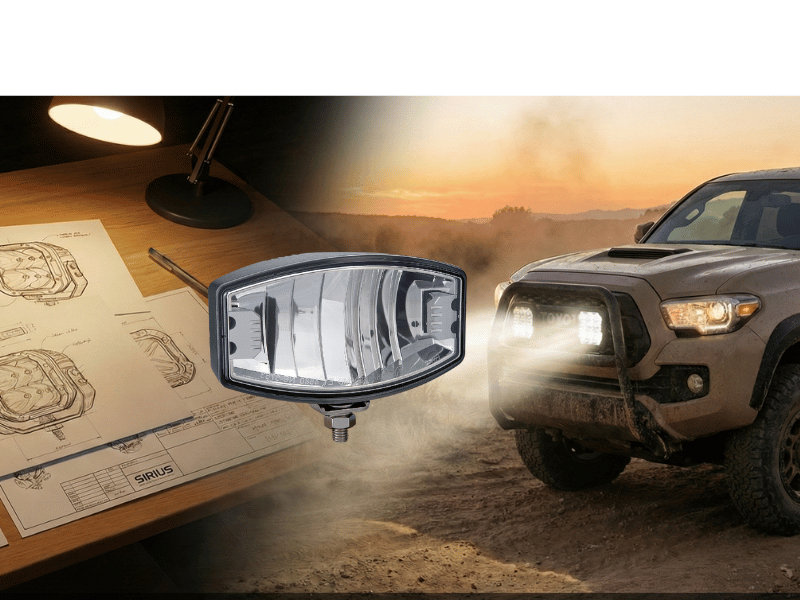
Whether on high-speed highways, rural roads, or remote off-road trails, drivers today demand lighting systems that extend reaction time and improve hazard detection. Traditional factory headlights often fall short when facing unlit wilderness roads, heavy weather conditions, or long-distance night driving. This is why LED driving lights have become an essential upgrade for modern vehicles, overland builds, commercial fleets, and professional off-road applications.
In this article, SIRIUS Light Technology Co., Ltd., established in 1983 and backed by over 40 years of automotive lighting R&D experience, shares a manufacturer’s perspective on how professional-grade LED driving lights are engineered for long-range visibility, durability, and international compliance. As a trusted OEM and ODM partner for global modification brands and fleet operators, SIRIUS designs lighting systems that meet the extreme performance expectations of European and North American markets.
1. Long-Range Projection Starts with Optical Engineering, Not Just Lumens
Many buyers focus only on lumen output when selecting LED driving lights. While brightness matters, beam pattern control is the real determinant of usable long-range visibility.
High-quality driving lights must focus LED output into a tightly controlled beam that projects distance without scattering glare. SIRIUS achieves this through proprietary multi-surface reflector technology, which precisely directs high-lumen LED output into a concentrated long-range beam. This allows drivers to detect obstacles, wildlife, or terrain changes far earlier — significantly extending reaction time at highway or trail speeds.
For North American applications, where long stretches of unlit highways and overlanding trails are common, this projection performance becomes a critical safety factor rather than a cosmetic upgrade.
2. Beam Pattern Precision Prevents Dangerous Glare
In Europe and many regulated markets, auxiliary driving lights must deliver powerful projection without producing hazardous glare for oncoming traffic. European ECE R112 and R149 regulations require strict beam cut-off control and defined light distribution zones.
SIRIUS utilizes dynamic optical simulation systems during development, calculating the path of every reflector and lens surface to ensure precise beam shaping. This guarantees strong forward illumination while maintaining legal cut-off boundaries — a key reason SIRIUS remains a long-term ODM partner for first-tier European lighting brands.
This balance between distance and control separates professional-grade driving lights from low-cost aftermarket products that may cause inspection failures or road safety risks.
3. Electronic Compatibility with Modern Vehicle Systems
Modern vehicles integrate CANBUS networks, ADAS sensors, GPS modules, and radio communication systems. Poorly designed LED drivers can introduce electromagnetic interference, disrupting sensitive electronics.
SIRIUS driver circuits comply with high-level EMC (Electromagnetic Compatibility) and CISPR standards. This prevents radio noise, sensor disruption, or onboard system errors — especially important in premium European vehicles and commercial fleets equipped with advanced safety technologies.
This electronic stability is one of the key technical thresholds separating OEM-grade lighting suppliers from generic aftermarket producers.
4. Meeting DOT and ECE Standards for Global Road Legality
Auxiliary driving lights must meet different regulatory frameworks depending on the market:
- DOT / SAE compliance for North America
- ECE (E-Mark) compliance for Europe
SIRIUS designs driving lights to meet both frameworks, enabling global OEM and ODM customers to deploy products across multiple regions without redesigning hardware. For North American platforms such as Jeep Wrangler, Ford F-Series, and heavy-duty trucks, SIRIUS also provides integrated mounting brackets and electronic control modules, allowing rapid deployment into vehicle-specific kits.
This regulatory readiness shortens time-to-market for brand partners and ensures legal road use for end customers.
5. Durability for Off-Road and Commercial Applications
Driving lights used in overlanding, construction fleets, or emergency vehicles must withstand:
- Continuous vibration
- Water and dust exposure
- Impact shock
- Extreme temperature cycles
SIRIUS driving lights carry high IP waterproof ratings and use impact-resistant polycarbonate lenses with UV protection. Internal circuit boards are reinforced against vibration stress, ensuring reliable operation on rough trails, heavy machinery, and long-haul trucks.
This ruggedization allows consistent performance in real-world duty cycles where lighting failure is not an option.
FAQ
Q1: Are LED driving lights legal for road use?
Yes — as long as the lights comply with DOT (North America) or ECE (Europe) regulations and are installed according to local laws. SIRIUS designs driving lights to meet both regulatory frameworks.
Q2: How far can professional LED driving lights project?
Projection distance depends on reflector design and LED output. Properly engineered long-range driving lights can project usable illumination several hundred meters ahead, greatly extending reaction time.
Q3: Do high-power driving lights drain vehicle batteries?
Modern LED driving lights consume significantly less power than traditional halogen or HID lamps while producing higher output. Efficient driver design keeps current draw stable.
Q4: Will LED driving lights interfere with vehicle electronics?
Poor-quality lights may cause interference. SIRIUS driving lights are designed with EMC-compliant driver circuits to prevent disruption to CANBUS, ADAS, or radio systems.
Q5: Are driving lights suitable for off-road environments?
Yes. SIRIUS driving lights are built with rugged housings, vibration-resistant electronics, and IP-rated sealing for water, dust, and harsh terrain use.
Conclusion
True long-range driving performance is not achieved by brightness alone. It requires precise optical control, stable thermal management, electronic compatibility, and full regulatory compliance. This is why professional fleet operators, off-road builders, and automotive brands rely on engineering-driven lighting partners rather than commodity products.
With over four decades of manufacturing expertise, advanced R&D capabilities, and full OEM/ODM service integration, SIRIUS Light Technology delivers LED driving lights that redefine long-range visibility, safety, and durability for global markets.
If you are looking for an OEM / ODM partner that combines optical engineering mastery, global compliance knowledge, and Made-in-Taiwan manufacturing excellence, SIRIUS is ready to support your next lighting project.
Contact SIRIUS today to discuss custom LED driving light development and global supply solutions.